


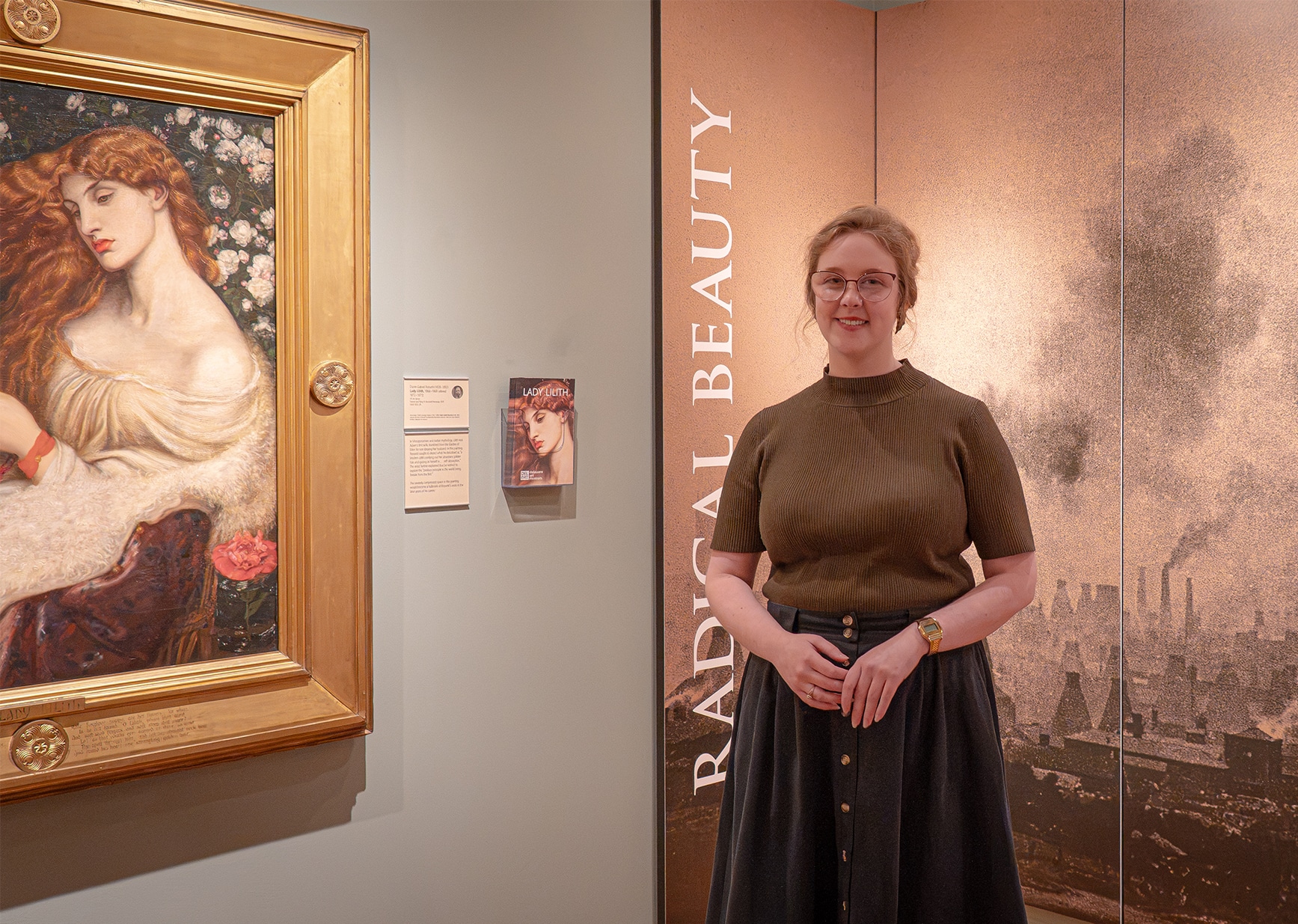
Amber R. Bowes was the 2026 Amy P. Goldman Fellow in Pre-Raphaelite Studies at the Delaware Art Museum. Over the summer, she spent a month in residence undertaking research in the Helen Farr Sloan Library & Archives in support of her doctoral dissertation, “Victorian Kitsch: Art Books, Gift Books, and the Invention of an Aesthetic Category.”
The Helen Farr Sloan Library and Archives at the Delaware Art Museum holds many beautiful decorative volumes of Victorian poetry – especially in the M. G. Sawyer Collection of Decorative Bindings and the Bancroft Pre-Raphaelite Collection. We have so many because there were so many: newly bound and organized collections and anthologies of verse made extremely popular holiday gifts all the way into the mid-twentieth century, and new editions were released each year for successive so-called Christmas markets. Lorraine Jantzen Kooistra, in her publication history of Christina Rossetti, describes the volumes of Victorian poetry sold during the early twentieth century as “cultural memory and nostalgia for a lost, irretrievable past.”1 These books were often bound in gilt-decorated publisher’s cloth in blue and green with rough deckled or smooth gilded edges, with woodcut-revival inspired design or color illustrations. These were portable pieces of capital-C-Culture for display on drawing room tables, but they were also, by nature of their giftability, sentimental objects.
Hints in a book’s style and construction can guide the reader whether to display the volume in pristine condition or to keep by the bedside for easy reference. Sometimes, though, the best way to tell a volume’s intended use is to read the inscription written within. One such object is The Story of Rosina, and Other Verses, released in 1895 by Dodd, Mead, & Co. Its author was Austin Dobson, a late Victorian poet and bibliographer whose work was relatively prevalent among contemporaries but whose star has since faded. This volume, bound in green cloth with a gold embossed title and design on the binding, is done after the style of the Macmillan Cranford Series, a popular line of giftbooks that released new volumes for holiday seasons from 1876 to 1907. Hugh Thomson, a very successful illustrator (best known now for the 1894 peacock edition of Pride and Prejudice, published by George Allen) decorated Rosina extensively. Dobson credits him in the book’s preface for all potential success, identifying Thomson as “an Artist whose hand is never so happy as when it works in the half-light of a bygone time.”2 Thomson is sometimes known as of the “wig and powder school”; his style is characterized by line drawings of historical costume, rococo embellishments, and (always) little cupids.
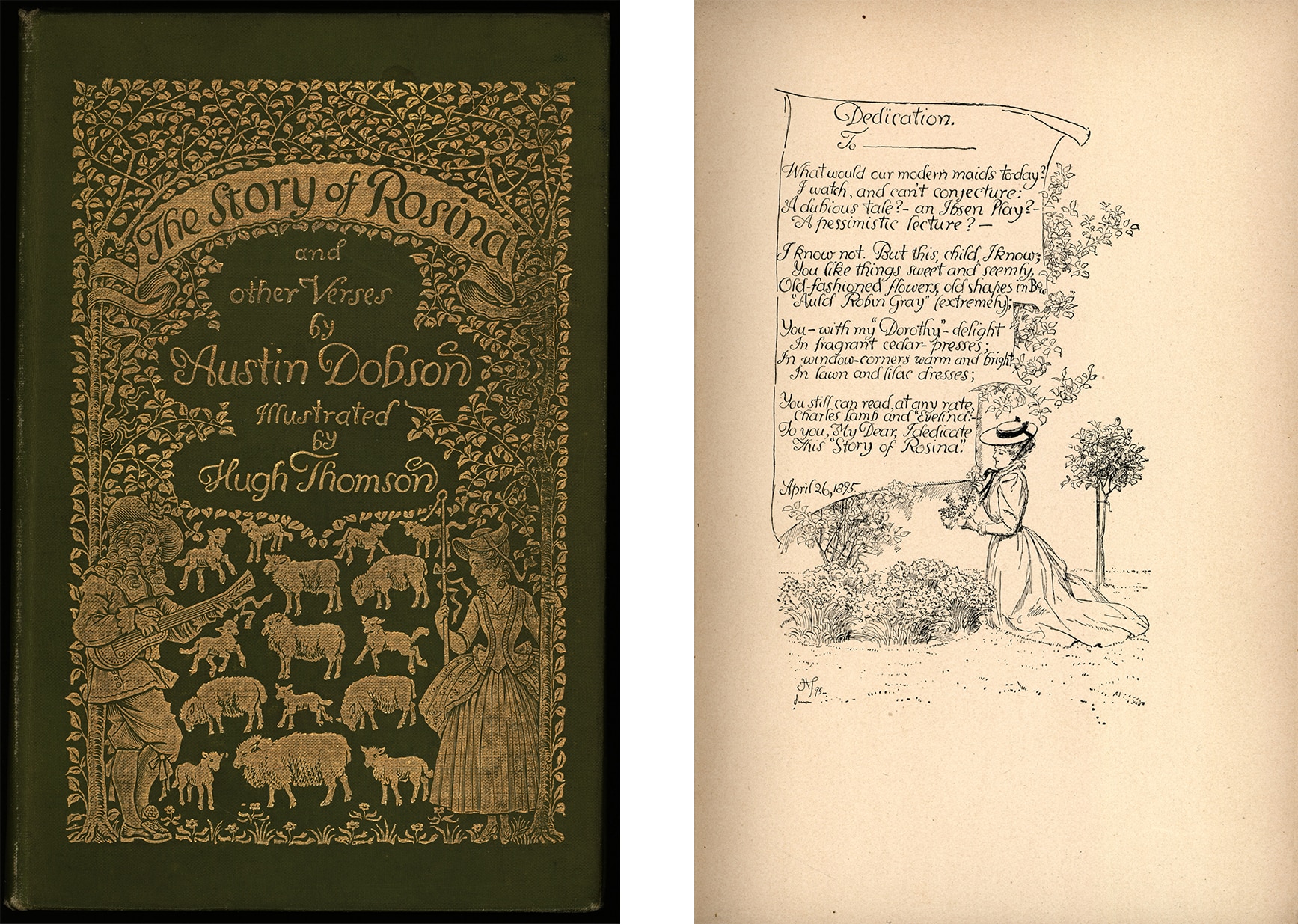 Binding (left) and dedication (right) of The Story of Rosina (New York: Dodd, Mead & Co., 1895). M.G. Sawyer Collection of Decorative Bindings, Helen Farr Sloan Library & Archives.
The Story of Rosina was designed specifically with gifting in mind, and Dobson and Thomson collaborated on an illustrated poem of dedication at the front of the volume in which the gifter can simply fill in the recipient’s name:
DEDICATION / TO _______ // What would our modern maids to-day ? / I watch, and can’t conjecture : / A dubious Tale ? – an Ibsen Play ? – / A pessimistic Lecture ? – // I know not. But this, Child, I know : / You like things sweet and seemly ; / Old-fashioned flowers, old shapes in Bow, / “ Auld Robin Gray ” (extremely) ; // You–with my “ Dorothy ” – delight / In fragrant cedar-presses ; / In window-corners warm and bright, / In lawn, and lilac dresses ; // You still can read, at any rate, / Charles Lamb and “ Evelina ” : – / To You, My Dear, I dedicate / This “Story of Rosina. // April 26, 1895
Despite their labors, this dedication poem was left untouched by the volume’s former owners, who instead were inspired to creation with a dedication poem of their own on the front endpapers:
C.B.F. to K.E. / Jan 22, 1906. // Accept this token / Of my devotion / Acquired by barter / from / Ray H. Carter.
The dedication’s final line, “Ray H. Carter,” is written in a different hand and with different ink, suggesting that the book was owned and signed by Carter before “C.B.F.” purchased it. He placed his bookplate near the inscription, reading “Ever let the fancy roam / Ex libris / Clifford Bailey Farr / M.D.” Though Dobson’s original dedication markets The Story of Rosina as a gift for a nostalgic young woman, this volume was valued by Carter and Farr, both men. The bookplate, Farr’s mention of “barter,” and the lineage of three owners revealed by this inscription show the book’s purpose to be that of a collectible; the endpapers can be marked for provenance, but the pre-illustrated and printed dedication with which the volume had come ready-made remains pristine. This does not mean that the volume’s contents were not appreciated, of course; why else would Farr write his little dedicatory poem in the style of Dobson’s light-hearted verse? The fading on the copy’s spine suggests that it stood upright on a shelf, or else spent time in a stack of books which protected the front and back of the binding from sun damage.
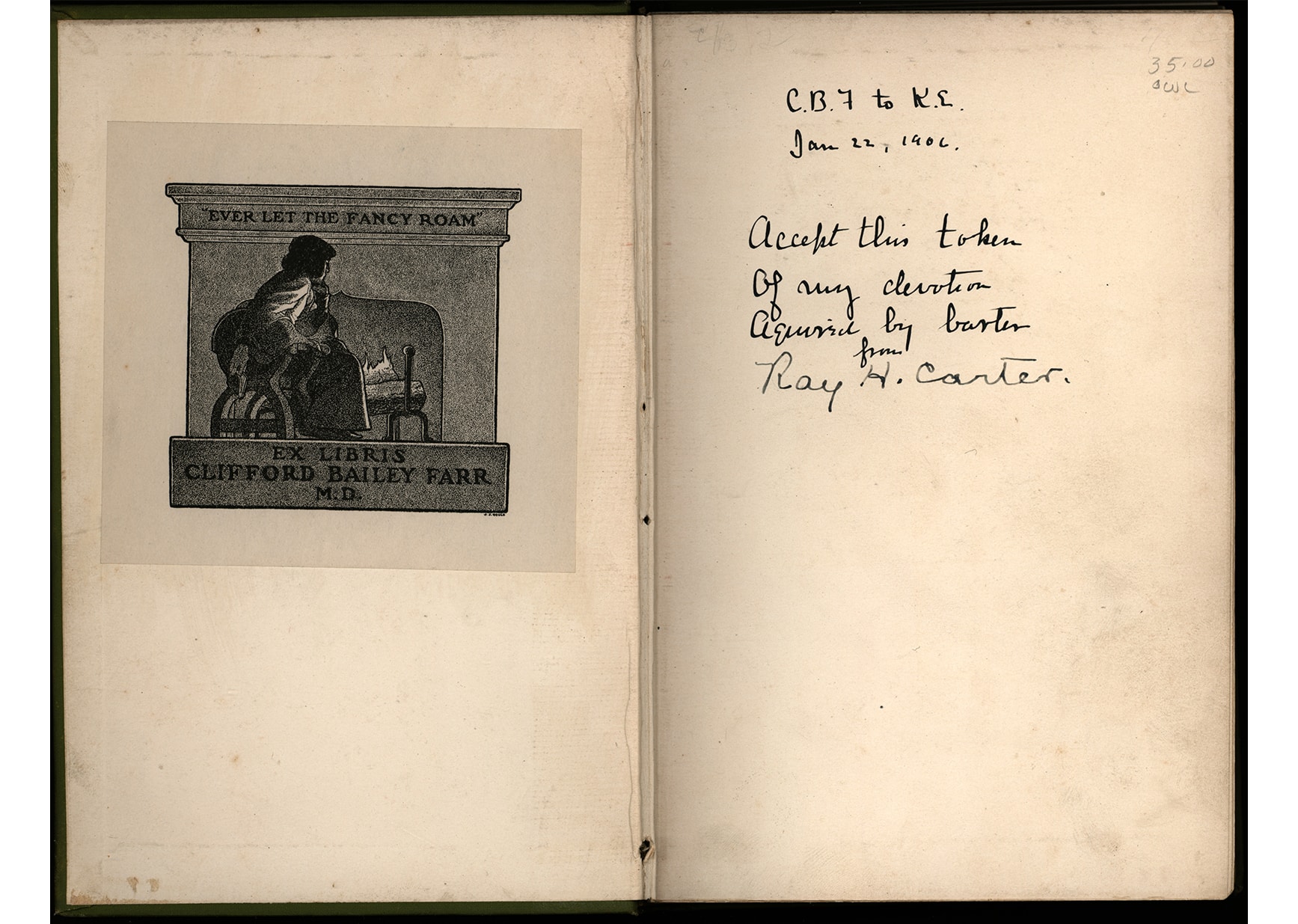 Inscription and bookplate within The Story of Rosina (New York: Dodd, Mead & Co., 1895). M.G. Sawyer Collection of Decorative Bindings, Helen Farr Sloan Library & Archives.
Other gift books were printed in more portable sizes than Rosina, such as this circa 1927 volume of Goblin Market and Other Poems. This copy prioritizes handheld proportions and tactile design, its soft, limp suede binding rendering it imminently holdable. Limp bindings were “revived by private presses” in the late nineteenth century, for “pocket editions” of poetry, and Carter and Barker write in ABC for Book Collectors that limp bindings were especially “popular for devotional books and sentimental verse” from around 1880 to 1920.3
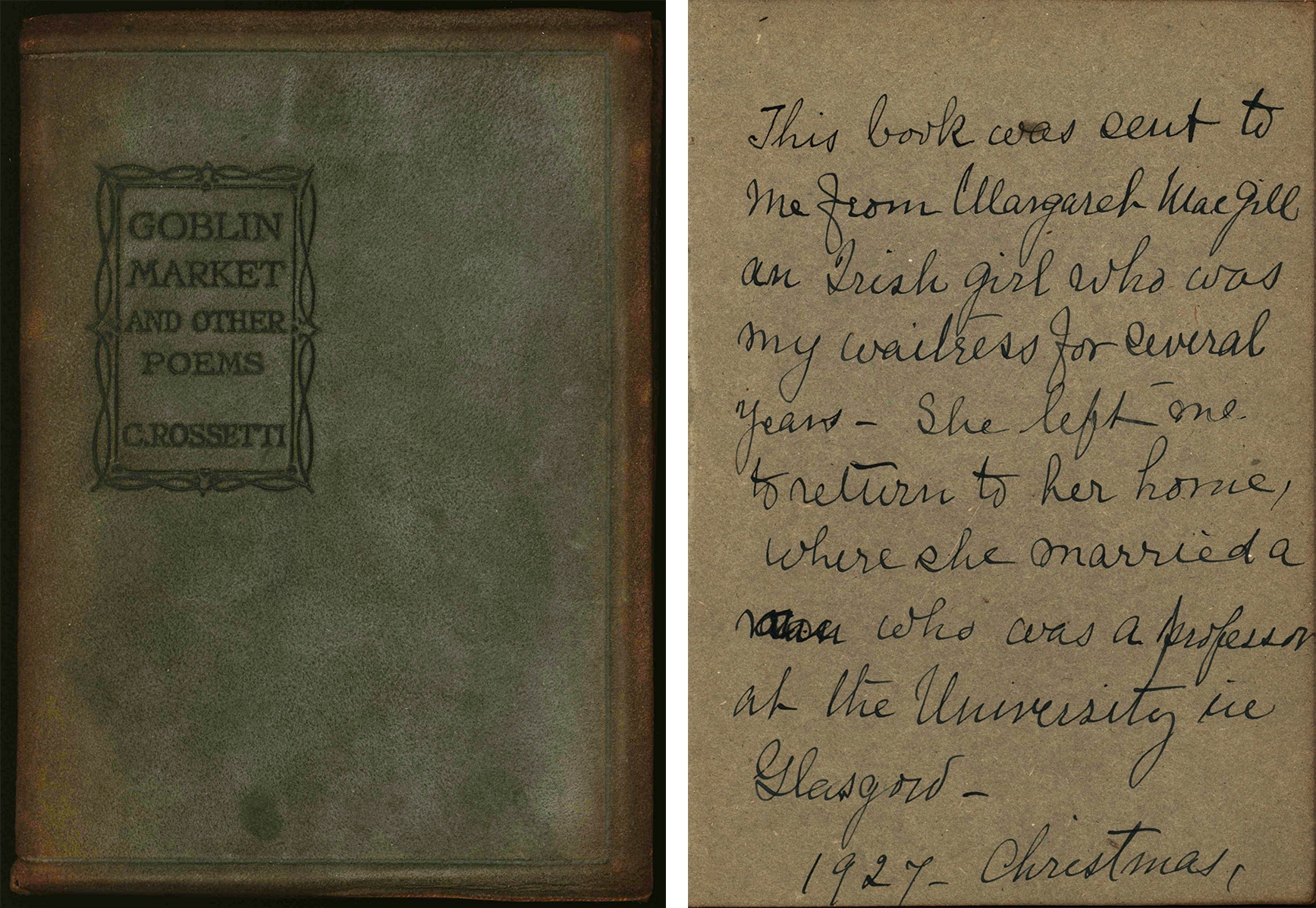 Front binding (faded) in limp suede and inscription inserted on brown cardstock, of Goblin Market and Other Poems (London and Glasgow: Collins’ Clear-Type Press, c. 1927). Bancroft Collection, Helen Farr Sloan Library & Archives.
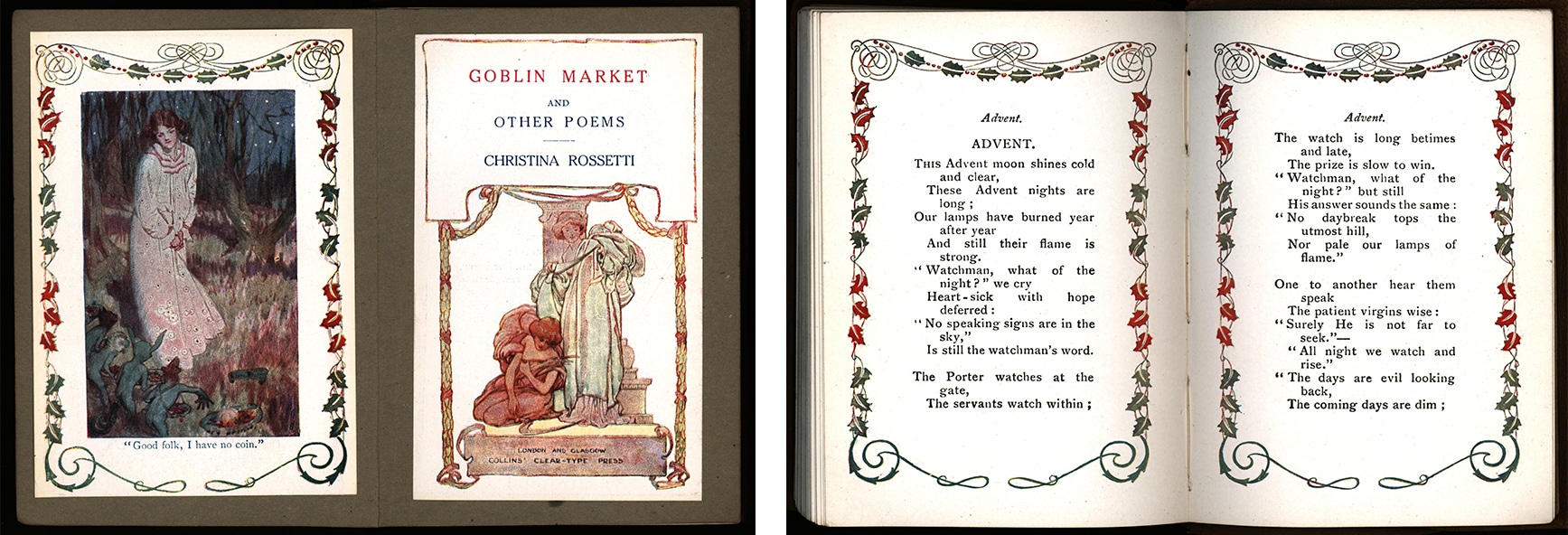 Original frontispiece and title page, trimmed and pasted onto brown cardstock and reinserted, and “Advent” with border consistent throughout.
The book was published by Collins’ Clear-Type Press, a Scottish publisher (born in 1892 out of the earlier company William Collins & Sons) that published many reprints of classics in the twentieth century, marketing their books as illustrated pocket editions. This volume also has yapp edges, a style of overlapping binding that offers some protection for the page edges by extending past the end of the paper. Yapp edges are most common in devotional books, subtly evoking the association of Rossetti with religious devotion.
This particular copy was a Christmas gift in 1927, bearing an inscription in the front that reads:
This book was sent to me from Margaret MacGill an Irish girl who was my waitress for several years – she left me to return to her home, where she married a man [this word scribbled over] who was a Professor at the University in Glasgow – 1927 – Christmas.
MacGill, the gifter, was a waitress working far from home, with no likely excess of disposable income. Her inscription’s tone gives the copy the feeling of a parting gift, for which occasion Rossetti seems an appropriate poet. The recipient has taken care to incorporate the brief story of MacGill into the volume through some craftiness in the copy’s initial pages, cutting out the title page and frontispiece (preserving the border of autumnal leaves) pasting them onto brown cardstock, and reinserting them into the volume. Their personalization, alongside the inscription’s contents and the book’s general wear, give the impression of a well-loved copy.
Inscriptions and additions to volumes like this one both root the copy in time and space (waitress from Ireland, 1927, Christmas) while simultaneously borrowing, for the addition, some of the more timeless aspects of books-as-objects. The gift-giving that was a fleeting event between two people, or even a long-distance communication (“This book was sent to me…”), is now memorialized and carried forward into subsequent readings of the book and into future libraries. Gifted volumes like this Rosina and Goblin Market leave us with a call to action unrelated to printed content. Through our engagements with them, we can remember to write in our own books and to share our books with one another – we never know when and how our own moments of connection may be preserved!
Amber R. Bowes
Amy P. Goldman Fellow in Pre-Raphaelite Studies, 2026
PhD Candidate, Indiana University Bloomington
Members of the public interested in viewing these books or others can make an appointment to see them with DelArt’s Librarian and Archivist, Rachael DiEleuterio at rdieleuterio@delart.org.
The Delaware Art Museum is currently accepting applications for its 2027 Amy P. Goldman Fellowship in Pre-Raphaelite Studies.
1. Lorraine Janzen Kooistra, Christina Rossetti and Illustration: A Publishing History (Ohio University Press, 2002), 237.
2. Austin Dobson, The Story of Rosina, and Other Verses (New York: Dodd, Mead & Co., 1895), xi.
3. John Carter and Nicolas Barker, ABC for Book Collectors, Eighth edition (Oak Knoll Press and The British Library, 2004), 144.