


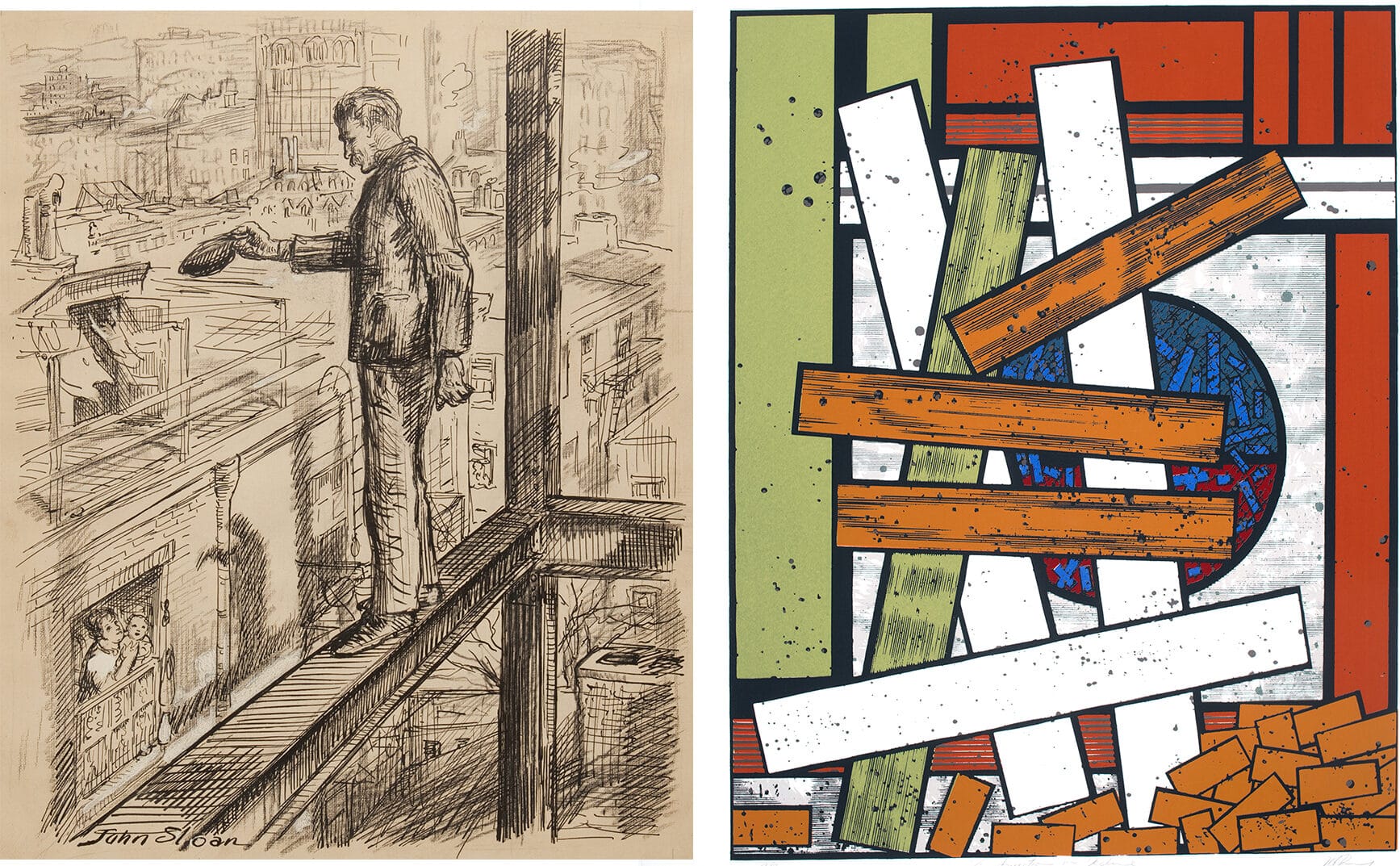
The fun of being a New York painter…is that landmarks are torn down so rapidly that your canvasses become historical records almost before the paint is dry.” In 1936, a writer quoted this observation from American realist painter John Sloan, who had arrived in the city more than thirty years earlier. Like generations of New York artists, Sloan chronicled the growth of skyscrapers and the spread of subway lines, as well as changing fashions and new retailers joining the urban grid.
The Sloan drawing featured in The City on Paper depicts urban transformation on a human level. A mother and child in a low-rise apartment building wave to a construction worker who stands on a beam above them. It was 1911 and New York neighborhoods were changing with the construction of taller structures. Sloan hints at the impact of this shift. Large, centered, and vertical, the man towers like the skyscraper that will soon loom over the three and four-story buildings across the street. The following year, Sloan would relocate as lower Manhattan evolved.
About sixty years later, Mavis Pusey captured the less appealing aspects of construction, focusing on the loose bricks and mismatched boards that clutter city sidewalks. Striated and splattered with debris, the materials hint at an abandoned project in a struggling city—New York in the 1970s. Her work reminds us that demolition and detritus are part of city living.
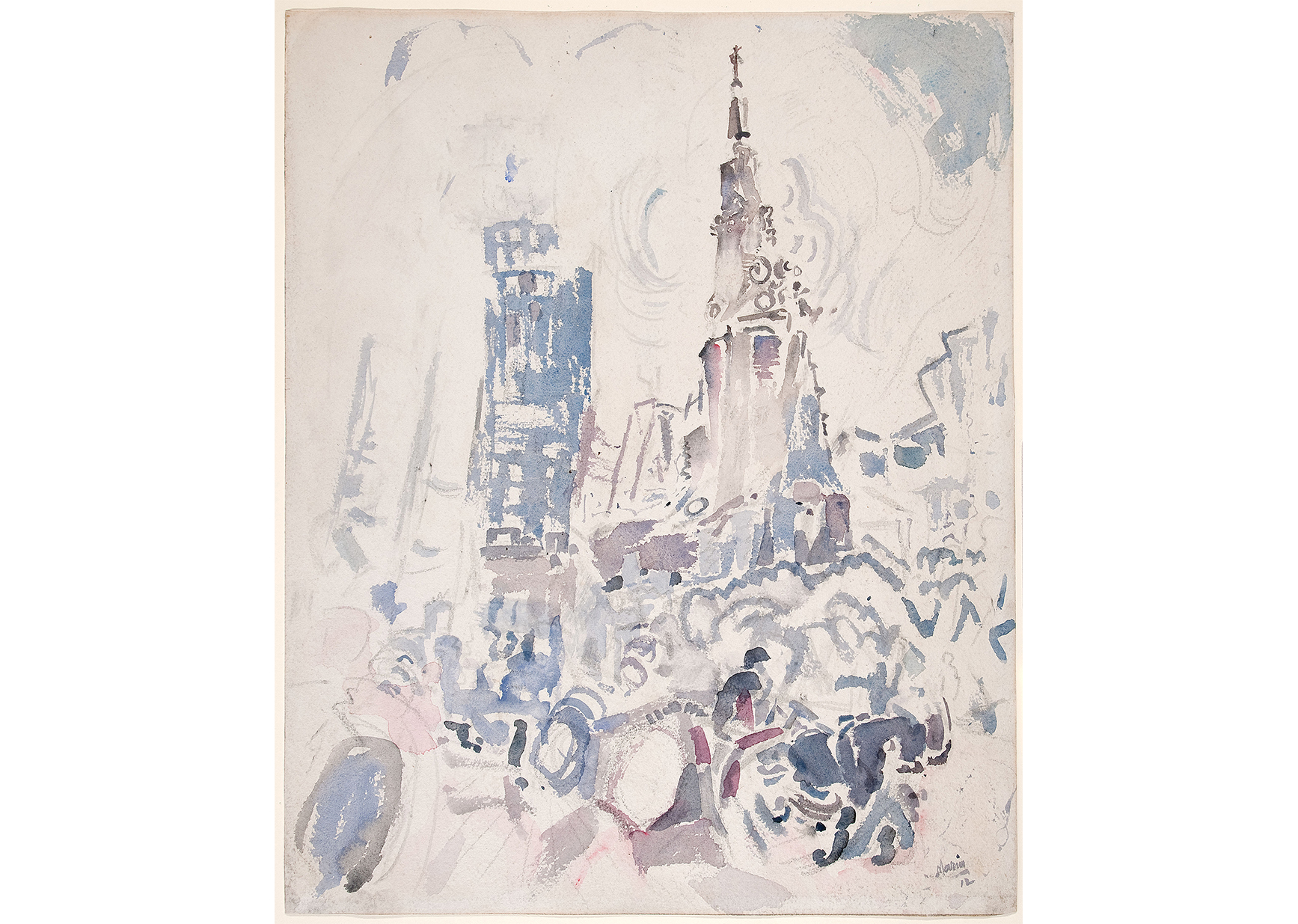 St. Paul’s, Lower Manhattan (Broadway, St. Paul’s Church), 1912. John Marin (1870-1953). Watercolor on paper. Delaware Art Museum, Gift of John L. McHugh, 1957.
The prints and drawings in The City on Paper encompass a range of urban experiences. Some artists focus on narrow streets and picturesque buildings, producing vistas with touristic appeal. Church spires appear repeatedly, often juxtaposed with businesslike blocks. For John Marin, New York City is all about motion. Even the spire of St. Paul’s vibrates with activity. Using angular lines and buildings that appear off-kilter, Marin conveyed the frenetic pace of the city. Looking at the foreground, one can imagine the experience of the hurried, jostled figures making their way through the streets of the metropolis.
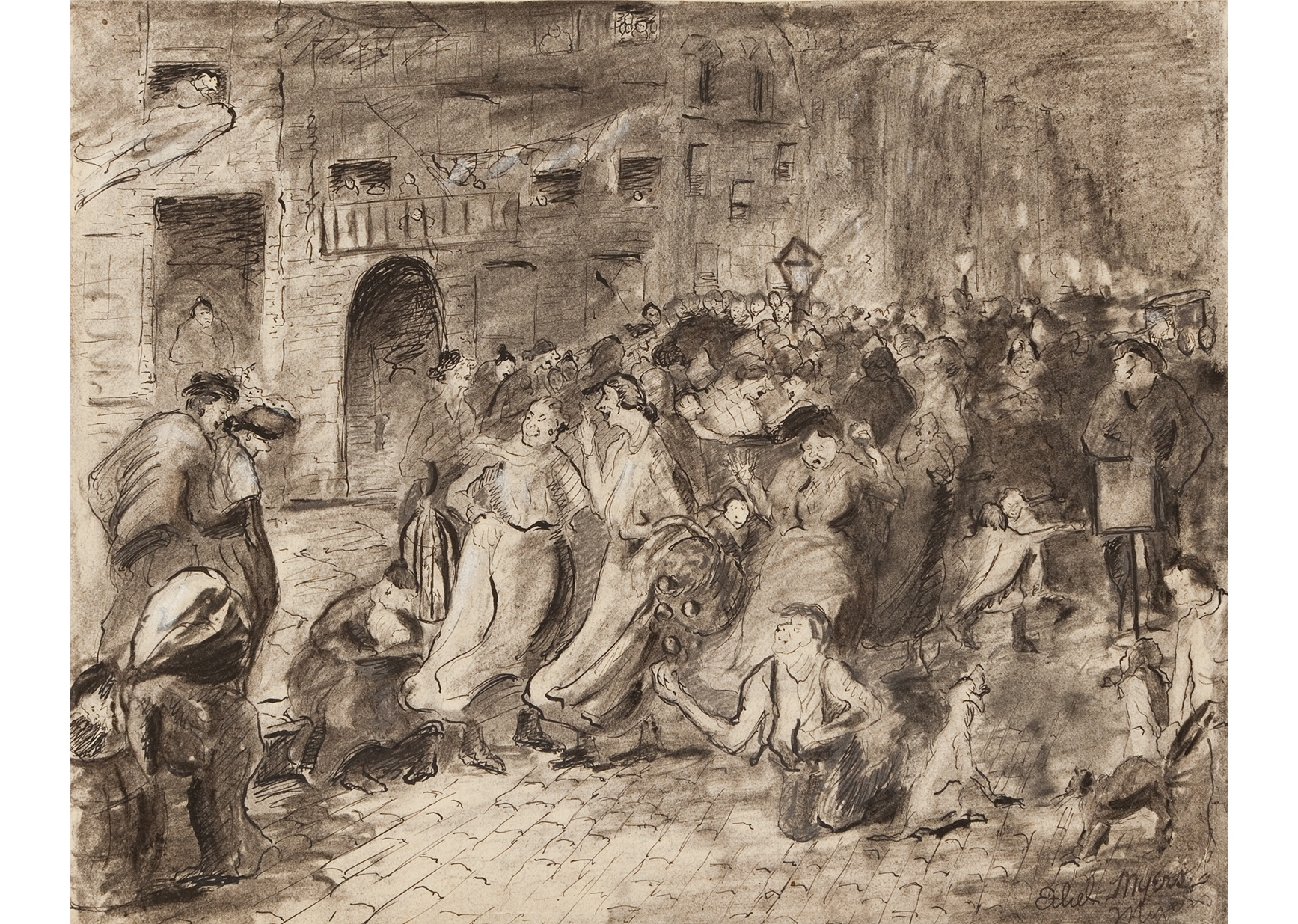 Street Scene, 1905. Ethel Myers (1881-1960). Ink and graphite heightened with white on paper. Delaware Art Museum, Gift of Virginia Downes, 1961.
Ethel Myers focused on that bustling crowd, setting her scene in a busy square. Figures are front and center, and even the architectural elements are distinguished by washing lines and faces sketched in windows and doorways. Myers’s city is alive with individuals.
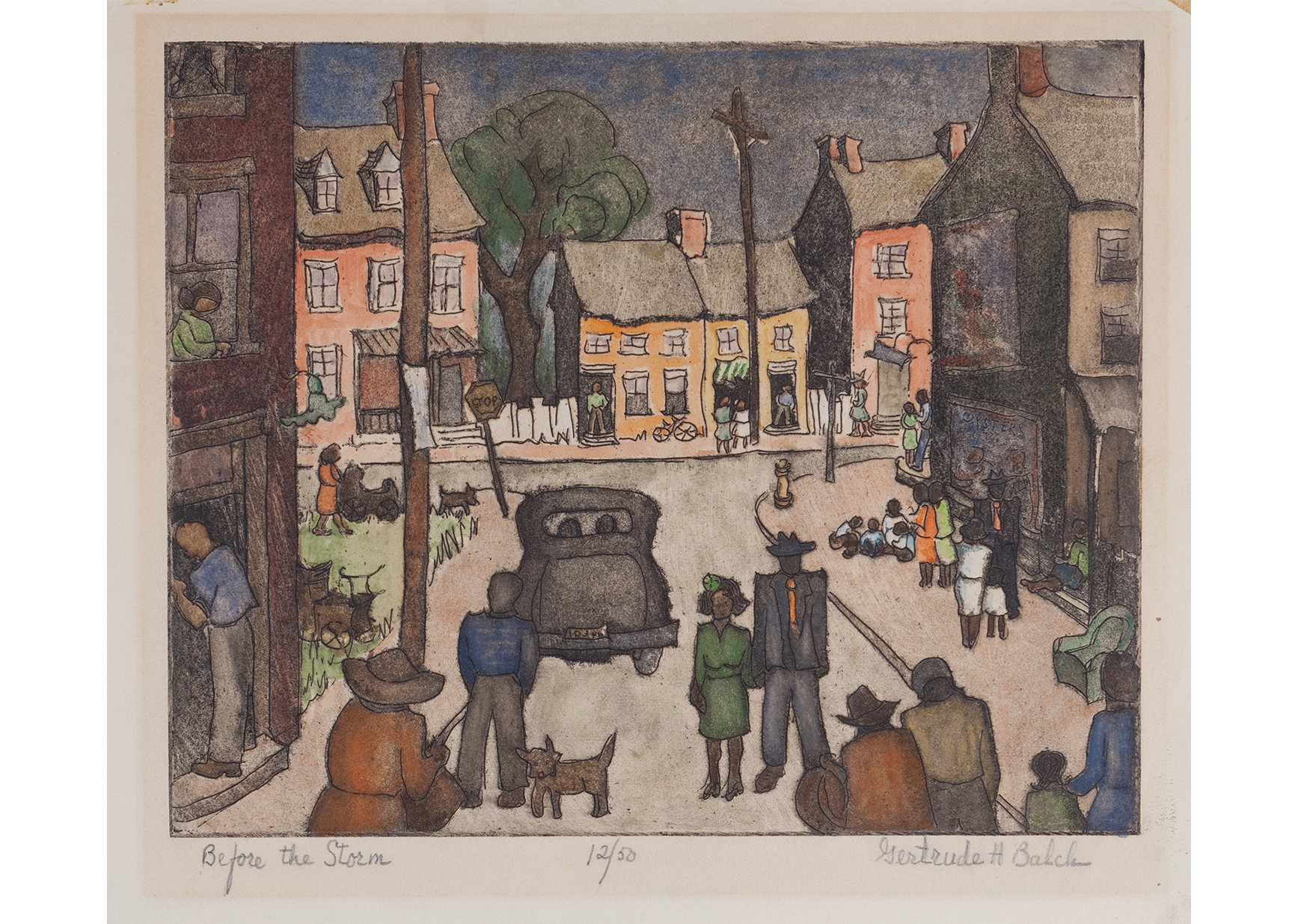 Before the Storm, c.1938. Gertrude Balch (1909-1964). Etching and aquatint with hand-applied color. Delaware Art Museum, Gift of Helen Farr Sloan, 1987. © Artist or Artist’s Estate.
More quietly, city dwellers and their homes are at the center of Gertrude Howland Balch’s delicate, hand-colored etchings. A local art teacher, Balch explored Wilmington’s residential neighborhoods, depicting modest row houses and shops, as well as working-class families. She displayed her etchings at the Delaware Art Museum and throughout the region. Many of her prints are preserved at the Delaware Historical Society, where they document aspects of our city that are gone today.
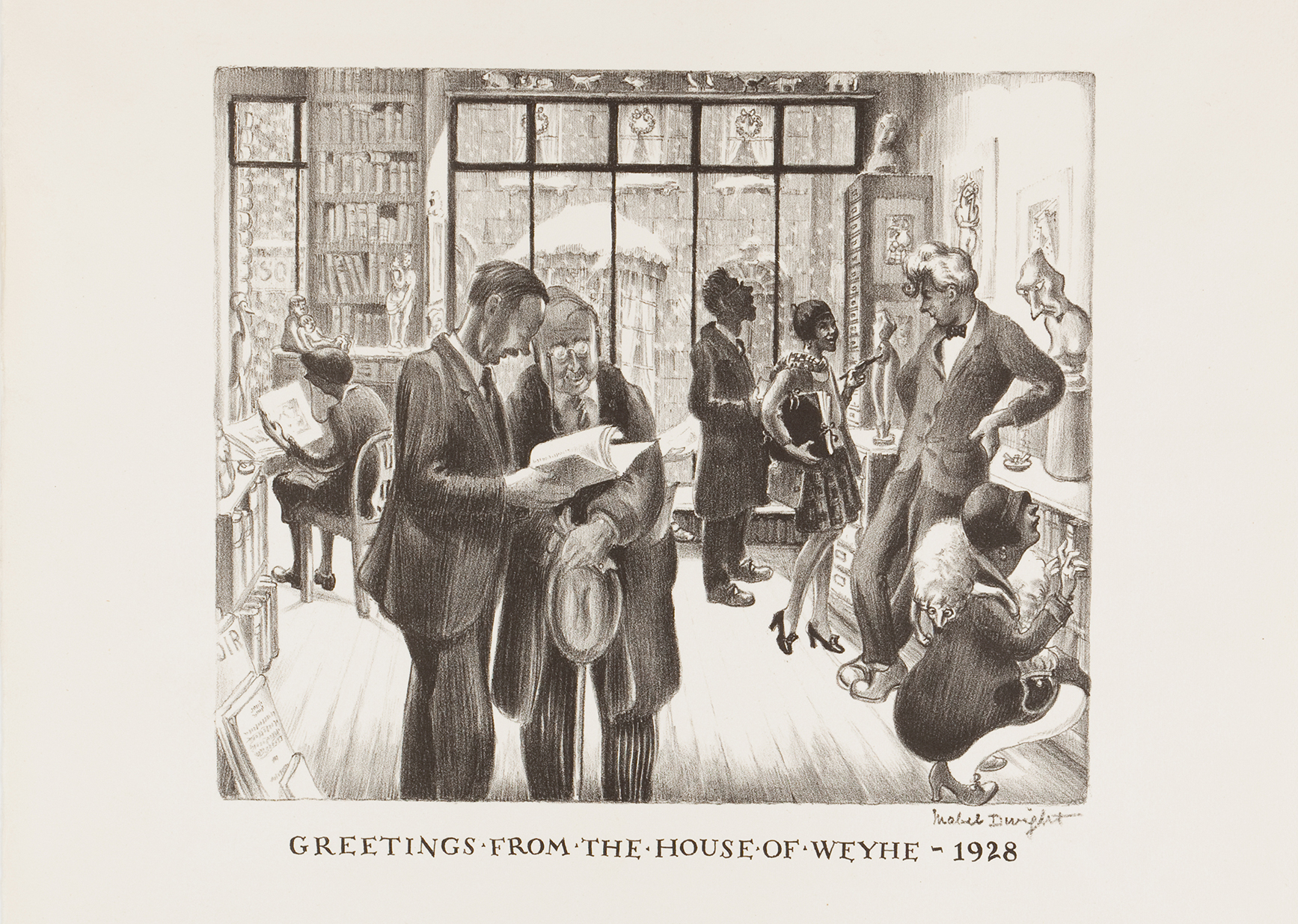 Greetings from the House of Weyhe, 1928. Mabel Dwight (1876-1955). Lithograph. Delaware Art Museum, Gift of Helen Farr Sloan, 1986.
The City on Paper brings together dozens of images of city life from New York to Chicago, Paris to Wilmington. Many are prints—etchings, woodcuts, lithographs, and even a monotype—and they represent more than one hundred years of urban imagery. This exhibition includes some of my favorite works in the collection and several exciting new additions, but as we researched the show, I was particularly drawn to a lithograph that Mabel Dwight made as a holiday greeting for the Weyhe Gallery in New York. Dwight captures the gallery from the inside, filled with people talking about art, while snow falls outside on Lexington Avenue. Dwight’s print serves as a reminder that art, artists, and art lovers form the beating heart of every city. If you’re reading this, I hope you get a chance to come to Wilmington and enjoy The City on Paper, which is on view from March 28 to August 16, 2026.
 Written by Heather Campbell Coyle, Curator of American Art
Top, left to right: Salute, 1911. John Sloan (1871-1951). Ink, charcoal, and zinc white paint on paper. Delaware Art Museum, Gift of Helen Farr Sloan, 1991. © Delaware Art Museum. Construction in Decline, c.1970. Mavis Pusey (1928-2019). Ten-color screen print. Delaware Art Museum, Acquisition Fund, 2023. © Estate of Mavis Pusey.