


A Love Letter to Artists, this Expansive Exhibition Centers Creative Labor, Public Service, and National Reflection Ahead of America’s 250th Anniversary
For the nation’s 250th, the Delaware Art Museum is building a living artistic record—honoring Delaware’s past and empowering future generations to tell its story through art.
“Citizen Artist is a love letter to artists.” With this guiding sentiment from exhibition co-curators, DelArt’s Head Curator and Curator of Contemporary Art, Margaret Winslow, and Lynn Herrick Sharp Curatorial Fellow, Dorothy Fisher, the Delaware Art Museum (DelArt) opens Citizen Artist, a sweeping and timely exhibition celebrating the enduring role of artists as essential workers—those who document, interpret, and shape the American experience.
Featuring 218 objects, including loans from institutions like the Museum of Modern Art and Baltimore Museum of Art, Citizen Artist places artists at the center of a broader narrative that encompasses their often unsung labor and advocacy for artists’ rights as workers, while highlighting their vital contributions to shaping the American landscape and preserving its history. Bifurcated across two distinct periods—the 1930s–40s New Deal era and a similar, though lesser-known initiative of the late 1970s—this exhibition underscores a powerful narrative: artists are not only creators, but also historians, storytellers, and visionaries whose labor has long been intertwined with the public good.
A Love Letter to Artists
Exploring the reciprocal relationship between artists and communities
At its core, Citizen Artist is a story of mutual support—how government investment in artists has historically yielded cultural, social, and economic benefits for communities across the nation. The exhibition honors artists who found opportunity and lasting impact through federally funded programs, specifically the New Deal and Comprehensive Employment and Training Act (CETA).
Rather than framing art as a solitary pursuit, Citizen Artist emphasizes collective effort. It demonstrates how artists mobilized their skills in the service of society, expanding access to culture while enriching public life. The exhibition honors how artists recognized their own potential, given proper funding infrastructure, to impact their communities and the nation.
Historic Relevance
Public support for artists through the New Deal and CETA
Margaret Winslow reflects, “I’ve always been fascinated with the vital role artists play shaping our country, especially during moments of uncertainty. Artists and their allies designed programs that mobilized the skills of professional out-of-work artists during both eras to serve their local communities. Citizen Artist looks at those movements both nationally, and right here in Delaware. What better time to reflect on these stories and consider how artists can help shape our future than on the eve of the 250th.”
The exhibition situates itself within two pivotal periods in American history: the Great Depression-era New Deal programs of the 1930s and 1940s, and the federally funded employment initiatives of the 1970s under CETA.
During the New Deal, artists advocated for inclusion as skilled workers and became integral to national recovery efforts. They documented the lives of everyday Americans, created murals in public spaces, expanded access to visual and performing arts, and helped define a shared cultural identity. These programs not only provided jobs but also reimagined the role of art in public life.
Decades later, CETA extended this legacy, funding an estimated 20,000 artists and arts administrators across the United States. Through locally driven initiatives, artists created programs tailored to community needs—from dance instruction and puppet shows to citywide mural projects, theater companies, and photography initiatives. These efforts transformed both the physical and cultural infrastructure of the nation.
By reflecting on this history and actively shaping how this moment will be remembered at the country’s 250th, DelArt is considering the vital labor of artists, whose creativity helps us interpret our past, understand our present, and push us to collectively imagine new futures.
Exhibition Experience
A dynamic, immersive exploration of two defining eras
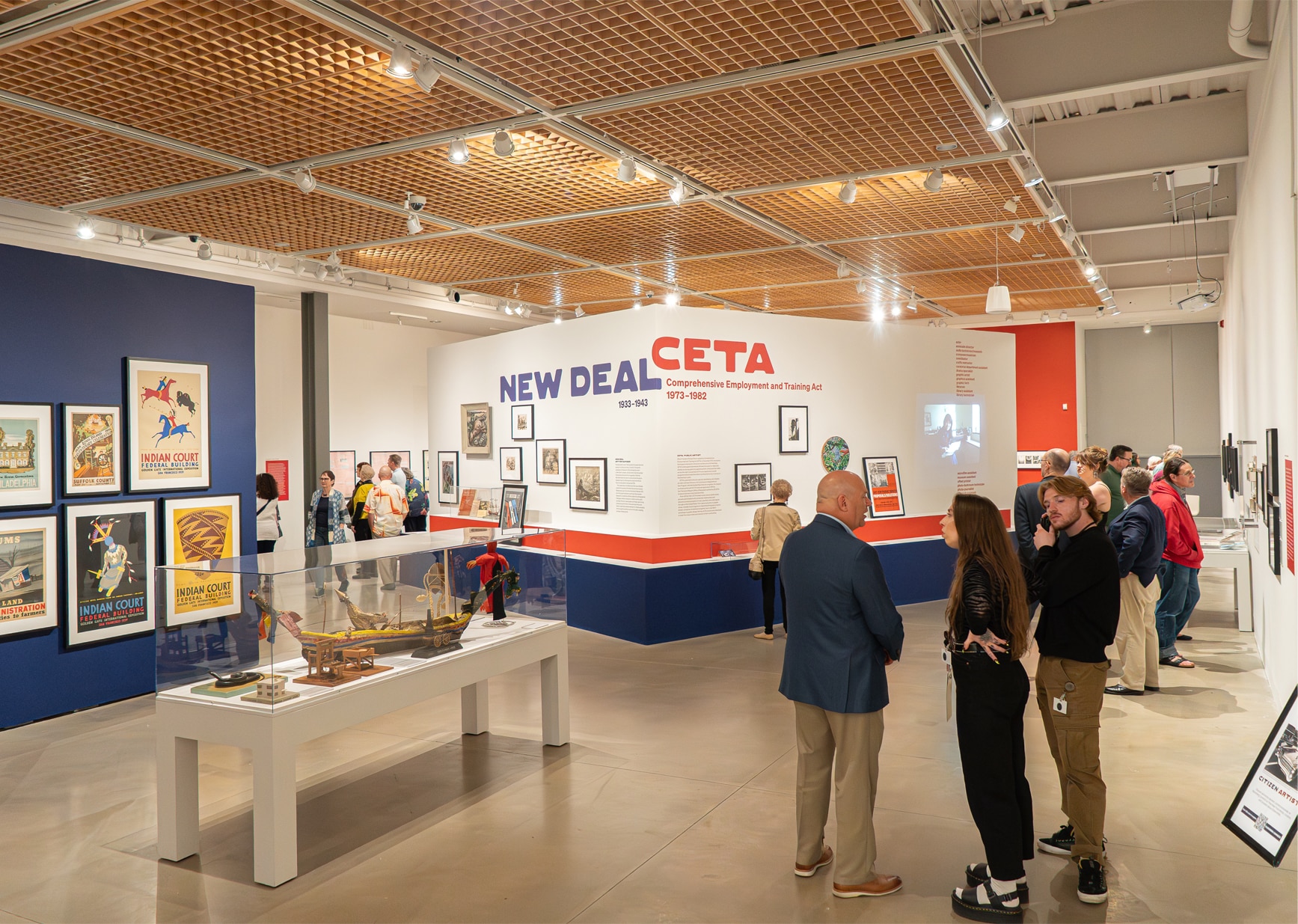
Visually and conceptually, Citizen Artist unfolds across two distinct sections—marked by blue for the New Deal and red for CETA—guiding visitors through more than 200 works by over 110 named and unnamed artists, including paintings, prints, puppetry, photographs, archival materials, and ephemera. Together, these objects trace interconnected histories of federally supported artistic production.
The New Deal section features work created for public consumption, from paintings, puppetry, documentary photography, and community-focused prints and posters, highlighting the breadth of artistic output made possible through federal investment. In contrast, the CETA section presents in-depth case studies from cities such as Buffalo and New York, as well as Delaware, offering insight into how these programs operated on the ground through photographs, artist records, and site-specific art and ephemera.
Enhancing the experience, visitors can engage with multimedia elements through the Bloomberg Connects app, featuring commentary from artists, curators, and scholars. The gallery is further animated by music from a 1976 performance by CETA-funded artists, alongside documentary photography from Delaware’s Bicentennial-era programming.
Local Connections
Delaware’s vibrant legacy of artist-driven community engagement
“I’m excited for visitors to see Delaware’s place in an important national story,” Dorothy Fisher shares, “The work of local artists on view in Citizen Artist is part of our region’s cultural heritage, and Citizen Artist is as much a tribute to those artists as it is a call to carry those traditions forward in our stewardship of the arts today.”
The impact of these federally funded initiatives is deeply woven into Delaware’s cultural fabric—and into the very foundation of the Delaware Art Museum itself. From shaping its early collection to expanding its role as a community-centered institution, these initiatives transformed both the state’s artistic landscape and DelArt’s mission to serve the public through art.
When New Deal programming ended in 1934, administrators in Philadelphia allocated works by Delaware and Philadelphia artists to the Wilmington Society for Fine Arts, now the Delaware Art Museum. These acquisitions, including works by William D. White and Michael Gallagher significantly shaped the Museum’s collection, embedding the legacy of federally supported artists into its foundation and expanding public access to American art.
Delaware played a significant role in the CETA arts movement. Beginning in early 1975 with initiatives like CITYSIGHTS/CITYSOUNDS in Wilmington, artists contributed to a wide range of community-based programs celebrating the visual and performing arts, including murals, photography, exhibitions, jazz, classical and percussion music, and theater.
Across the state, artists and administrators leveraged CETA funding to implement and expand collaborative programs. Organizations as diverse as Dover Modern Maturity Center, Delaware Art Museum, Girls Clubs of Delaware, United Way of Delaware, Winterthur Museum, Hagley Museum and Library, and the Salvation Army all benefited from the labor and skills of artist workers through CETA-funded initiatives. From the development of photography education programs at the Delaware Art Museum to DelArt’s community education program, offerings grew to include loaned circulating exhibitions and multidisciplinary in-classroom workshops.
This exhibition brings all this together as we mark the nation’s 250th anniversary. DelArt is building a living artistic record—one that honors Delaware’s histories while empowering future generations to understand, reinterpret, and tell Delaware’s story through an artistic lens.
Citizen Photographer Initiative
A contemporary call to civic reflection
Inspired by these historical precedents, the exhibition features the dynamic Citizen Photographer installation, presenting 24 images by 24 Delaware residents—representing each county—responding to the question: What does it mean to be a Delawarean at the nation’s 250th anniversary?
Building on the legacy of New Deal–era initiatives and CETA, the Citizen Photographer project was supported by the Delaware Division of the Arts in honor of the 250th. Developed in collaboration with community partners—including Wilmington’s Teen Warehouse, the Smyrna Opera House, and the Lewes Public Library—the project was guided by collection artists Morris Brown II, B. Proud, and Andre’ Wright, Jr., who served as project leads and jurors, mentoring participants and selecting works for inclusion.
By inviting community members to engage in civic reflection and shape public perceptions of identity through photography, the exhibition further underscores its role as both a tribute and a call to action—affirming that investing in artists is, ultimately, an investment in society itself.
“A twin pillar to freedom of speech is cultural expression,” said Molly Giordano DelArt Executive Director. “The Delaware Art Museum is dedicated to preserving and interpreting culture through art. For the 250th, we view this milestone as a vital opportunity to highlight the essential role artists play in our society.”
On view through July 19, Citizen Artist offers a profound and timely meditation on the role of artists in shaping the American story.
Sponsors
This exhibition is supported by Delaware 250. This organization is supported, in part, by a grant from the Delaware Division of the Arts, a state agency, in partnership with the National Endowment for the Arts. The Division promotes Delaware arts events on www.DelawareScene.com.
About the Delaware Art Museum
The Delaware Art Museum is a nationally recognized regional museum that connects people through art and experience. Founded in 1912 to honor illustrator Howard Pyle, the Museum now houses over 13,000 works, including the largest Pre-Raphaelite collection outside the U.K. and a growing contemporary art collection. Its campus features galleries, a 6 acre sculpture garden, labyrinth, and event spaces—creating a dynamic center and vibrant cultural resource, offering exhibitions, classes, and community programs that reflect and engage the diverse Delaware community and beyond. Visit delart.org to for the latest exhibitions, programs, and performances or connect with us via social media.
IF YOU GO
WHAT: Citizen Artist
WHEN: Now through July 19, 2026
WHERE: Delaware Art Museum, 2301 Kentmere Parkway, Wilmington, DE 19806
COST: Included with Museum admission
INFO: delart.org/citizen-artist